Do You Install Cat Fences at Homes and Cat Rescues?
Yes, we install cat fencing at houses, townhomes, rentals, cat rescues, and sanctuaries. Most jobs are backyard fences, so tell us roughly how big the yard is and how many cats will use it.
Cat Fence Installation Kings provides cat fence installation, cat-proof fence toppers for existing fences, and freestanding cat enclosure fencing in the Rexburg, ID area for homes, rentals, and cat rescues. Contact us now for a free estimate.
Cat fence installation in Rexburg, ID costs anywhere from $1,060 to $3,080 on average to cat-proof an existing backyard fence of about 100 to 150 feet with one gate. The price depends on the length, the fence type and height, the number of gates and corners, trees and other climb points to block, and whether you need a freestanding fence instead of a topper.
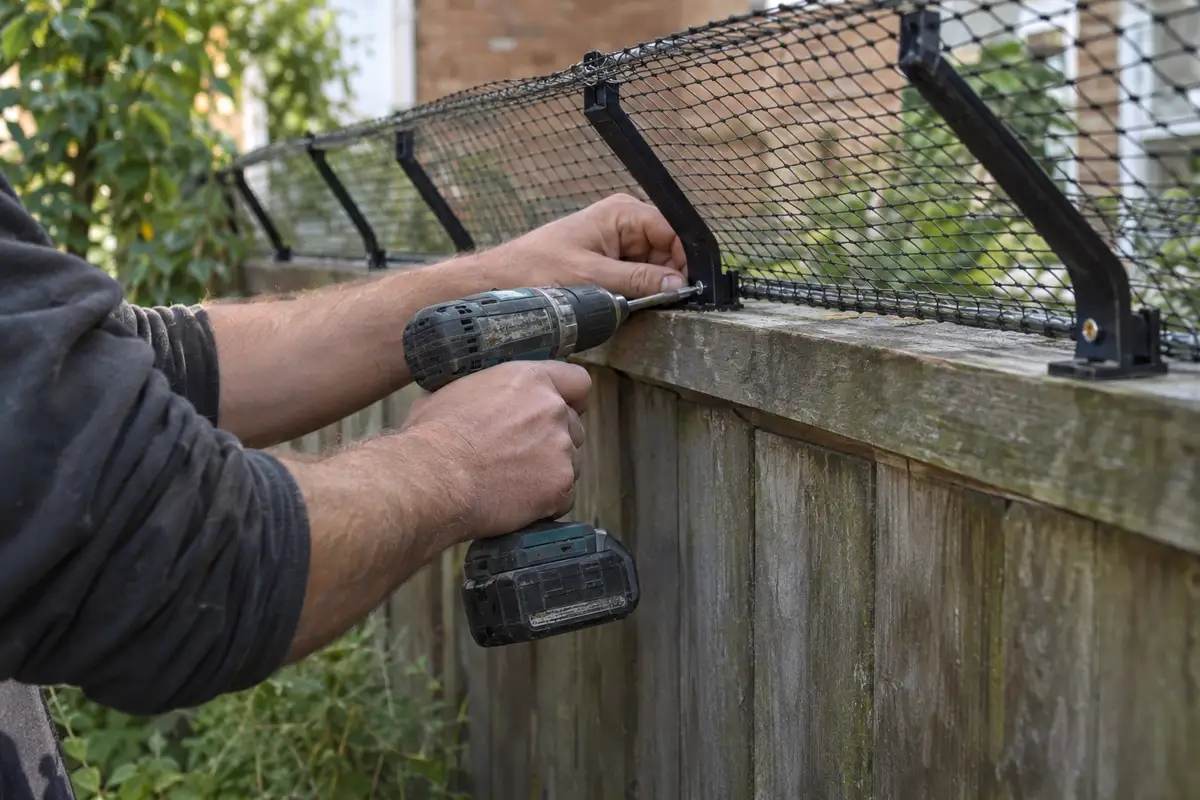
Yes, we install cat fencing at houses, townhomes, rentals, cat rescues, and sanctuaries. Most jobs are backyard fences, so tell us roughly how big the yard is and how many cats will use it.
Yes, we cover the Rexburg, ID area. Send us the property address and we'll confirm.
No, not for the building permit alone if the total stays at 7 feet or less. Rexburg says fences over 7 feet must obtain a building permit. Its code also lists rear yard fences at 3 to 6 feet, so a topper that lifts a 6 foot fence higher may still raise a height question. We measure first and suggest checking with the city.
Yes, in most cases we add an inward-angled topper to your existing fence, with an arm on each post every 8 to 10 feet and mesh between them. The fence has to be sound and free of gaps a cat can squeeze through.
We aim for at least 6 feet from the ground to the tip of the topper arm. A plain 6 foot fence rarely stops a cat on its own.
Our topper arms lean inward over the yard, so a cat would have to hang upside down to get past. Spring-loaded arms also drop when the cat climbs on, so it lets go and lands back in the yard.
No, no system can promise that, because every yard is different. Most escapes happen at trees, corners, gates, house ends, and gaps under the fence, which is where we spend most of our time.
Yes, we install kits customers buy themselves, including spring-arm mesh systems, netting kits, and roller bars. Tell us the brand and the feet of fencing you ordered, and have it on site before we come.
We can usually schedule an install once the materials are on hand. If we supply the kit, shipping time is typically what sets the date, so tell us if you already have one.
We need a rough sketch of the yard with side lengths, gate locations, your fence type and height, and photos. Point out trees, sheds, AC units, and anything else near the fence a cat could climb.
No, rough measurements and photos are enough for a first price. We measure post to post ourselves before ordering materials.
No, as long as we can get into the yard and you've approved the layout. Please keep your cats indoors until we tell you the whole perimeter is closed.
No permit is usually needed for a topper on an existing fence, but many towns cap fence height and an HOA may have rules on additions. Check with your HOA and local zoning office before we start.
Yes, with your landlord's written permission. These systems are semi-permanent, so they can come off when you move, with screw holes in the fence posts being the main mark left.
Yes, we confirm the price from your sketch and photos before starting. If a loose post, rotten rail, or a gap under the fence needs fixing first, we price it separately and ask before doing it.
We finish most backyard conversions of 100 to 150 feet in one day. Freestanding fences, many trees, or fence repairs can make it a longer job.
Yes, we screw the topper arms to the wood posts and run the mesh between them. Tell us the fence height and whether any posts or boards are loose.
Yes, we clamp the arms to the chain link posts with hardware made for it. Chain link usually doesn't sit flush with the ground, so we often add a dig guard along the bottom.
Yes, we use mounting hardware made for vinyl and PVC posts so we don't crack them. If your cat digs, we can add a guard along the bottom too.
Yes, we anchor the arms into block or brick with masonry fasteners. Tell us the wall height and whether it has a cap on top.
Yes, we use a taller extension that adds up to 3 feet, so the arm tip ends at least 6 feet up.
No, not with a topper, since the gaps are big enough for a cat to walk through. We set a freestanding mesh fence just inside it instead.
Yes, we install freestanding cat fencing with posts up to 14 feet apart, set 6 to 7 feet tall, with mesh and inward arms on top.
Yes, a freestanding fence can enclose any section you choose, running off the house wall. That also keeps cats away from trees, sheds, and AC units outside the enclosure.
Yes, we fit mesh gates in freestanding fences or add extra arms at an existing gate. For a gate you use every day, we can build a header over it so the fence runs across the top.
Yes, we mount aluminum rollers along the top of the fence that spin when a cat grabs them, so it can't get a grip. Tell us your fence height and type.
Yes, in most cases. We fit mesh and arms to the railings and posts, so send us photos and measurements of the space.
Yes, we wrap smooth trunks in a guard cats can't grip, trim low branches to about 3 feet, or run the fence around the tree. Tell us how far each tree is from the fence.
Yes, house ends need extra arms. If the fence meets the wall less than about 22 inches from the building corner, we wrap arms around the corner so the cat can't slip past sideways.
Yes, we cover the top of an AC unit with a slanted guard that leaves room for airflow, and wrap posts in metal flashing. A shed near the fence can be built into the fence line.
Yes, we add a dig guard or pavers along the base and close the low spots.
Yes, we set the arms at a steady slope that follows the overall grade instead of stepping them with each panel, which avoids weak points at every post.
Yes, we find the escape route, often a corner, tree, or gate, and close it.
No, not reliably. Cat fences are built to keep cats in, so outside cats can still climb over, and they aren't designed to stop coyotes. We still recommend bringing cats in at night.
Yes, move grills, trash cans, benches, and patio umbrellas a few feet from the fence, since cats use them to jump out. We'll point out any others we find.
No, usually not. The poly mesh is hard to see from 15 to 20 feet away, and the arms lean into your yard, not toward the neighbors.
No, rarely. Wind passes through the mesh, and the fence can stay up all winter.
Yes, if you want your cat to have the whole yard. A catio has a roof, so it's more secure and keeps cats away from birds, but it covers much less space. Tell us how much of the yard you want your cat to use.
Yes, most kits are made for a handy homeowner and take a weekend. People hire us mainly for the tricky parts, like corners, gates, house ends, and trees, where most DIY escapes happen.
Many well-installed mesh systems stay in use 15 years or more. Keeping vines and heavy branches off the mesh helps it last.
Yes, we can extend it with more arms and mesh, or take it down if you move, since it's screwed or clamped on rather than built into the fence.
